

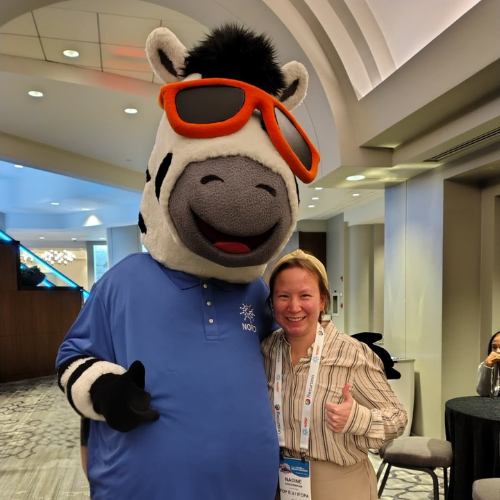
A Conversation with Nadine: Living Well Through the Pursuit of Knowledge
By Isabel Edwards
Last year, we shared our commitment to Metabolic Support UK’s ‘Living Well’ movement, highlighting stories from our community, both in the UK and beyond, about the ways they endeavour to live well with FOP.
As part of this ongoing movement, our wonderful blogger, Isabel, met with Nadine to hear how she strives to live her best life and navigate the unique challenges of the condition with such positivity:
“I admire how everyone deals with FOP in their own, unique ways.” Nadine
Amid a Summer filled with hectic deadlines and research commitments, Nadine was able to find a momentary pause within her busy schedule to sit down and share her perspective of what it means to Live Well. Her words are motivated her desire to give back and support the FOP community that has been central to her practise of Living Well.
“I try to enjoy every day to its fullest,” she tells me. “To find joy and beauty in the little things, and to not postpone them, but to do them as soon as I can.” This philosophy wasn’t instant, it developed over time. What helps most, she adds, is “knowing that there is a community who always has my back.” It’s that sense of belonging that fuels her commitment to contribute something meaningful to celebrate them.
The Art of Listening to One’s Body
For Nadine, the Living Well Movement coexists as something collective but also deeply personal. “Although we share a community, Living Well has to be nuanced for each person,” she reflects. “FOP presents differently in everyone, and so does life.”
She puts a few spaces before adding, ‘I look up to every individual living with FOP. I admire how every one deals with it in their own, unique way.”
Her own practise of Living Well is rooted in her mantra for self-love. “I don’t need to be able to keep up with others. On those days, I try to be especially kind to myself and not push too hard. Sometimes I just call it a day, go back to bed, or give myself some me-time.” It’s a gentle reminder that listening to your body is not a weakness – it’s your strength.
Unlocking the Wider Picture
Before her diagnosis, Nadine’s ambitions lay elsewhere. “I actually wanted to study something with languages,” she relates, “but the jobs related to languages didn’t sound very appealing to me. That’s why I started studying biology.”
It was around her early studies where she experienced her first flare ups of FOP, though her diagnosis hadn’t yet been confirmed. When she later began her PhD, she found herself drawn more deeply into the world of FOP research. “What really motivated me,” she says, “was out amazing community. Getting to know other individuals living with FOP, the researchers, the doctors—all of them inspired me. I wanted to contribute at least one puzzle piece to the big picture, to our shared quest for treatments and ultimately, a cure.”
The Motivation Behind her Research
When asked whether her own experience with FOP has shaped her approach to research, Nadine responds thoughtfully. “I try to keep in mind which research question would best serve individuals living with FOP – to improve their quality of life. In challenging times, it helps to remember who I’m doing all this for.”
Her work reflects that sense of purpose. “I hope my research can lay the foundation for new treatment approaches,” she says, “not just for FOP, but for the broader rare disease field. Maybe other researchers can apply some of my findings to their own questions.”
Nadine’s Wisdom On Living Well
When I ask Nadine about the advice, she would give to young people with rare conditions who are trying to balance their goals with their health, her response is both proactive and uplifting:
“Talk to peers and others who have pursued their goals. Listen to your body and don’t push beyond your limits—it will backfire at some point. And try things out. There is no shame in failing. Sometimes we need to fail to learn.”
Her motivation comes from the community around her—and the hope that research and community-led movements, will make things easier for future generations. “I wish for the next generation of FOPers to have a carefree childhood and life.”
Closing Reflections
As we wrap up, Nadine leaves me with a message that perfectly captures the heart of the Living Well Movement:
“We are more than our condition, and I wish people would see us for who we are—people.”
For students navigating university life with FOP, what she recommends in simple but vital:
“Connect with other disabled people and staff at your university. Learn what support you’re entitled to have. You need to actively ask for help—so don’t be shy and stand up for yourself.”
Most importantly Nadine reminds us that Living Well isn’t about perfection; it’s about connection, curiosity and kindness—both to others and ourselves.